Beginner's Guide to Freediving: How to Start Safely
How to start freediving without cutting corners: dry-land preparation, certified instruction, buddy protocol, equalisation, and a realistic first year in the water.
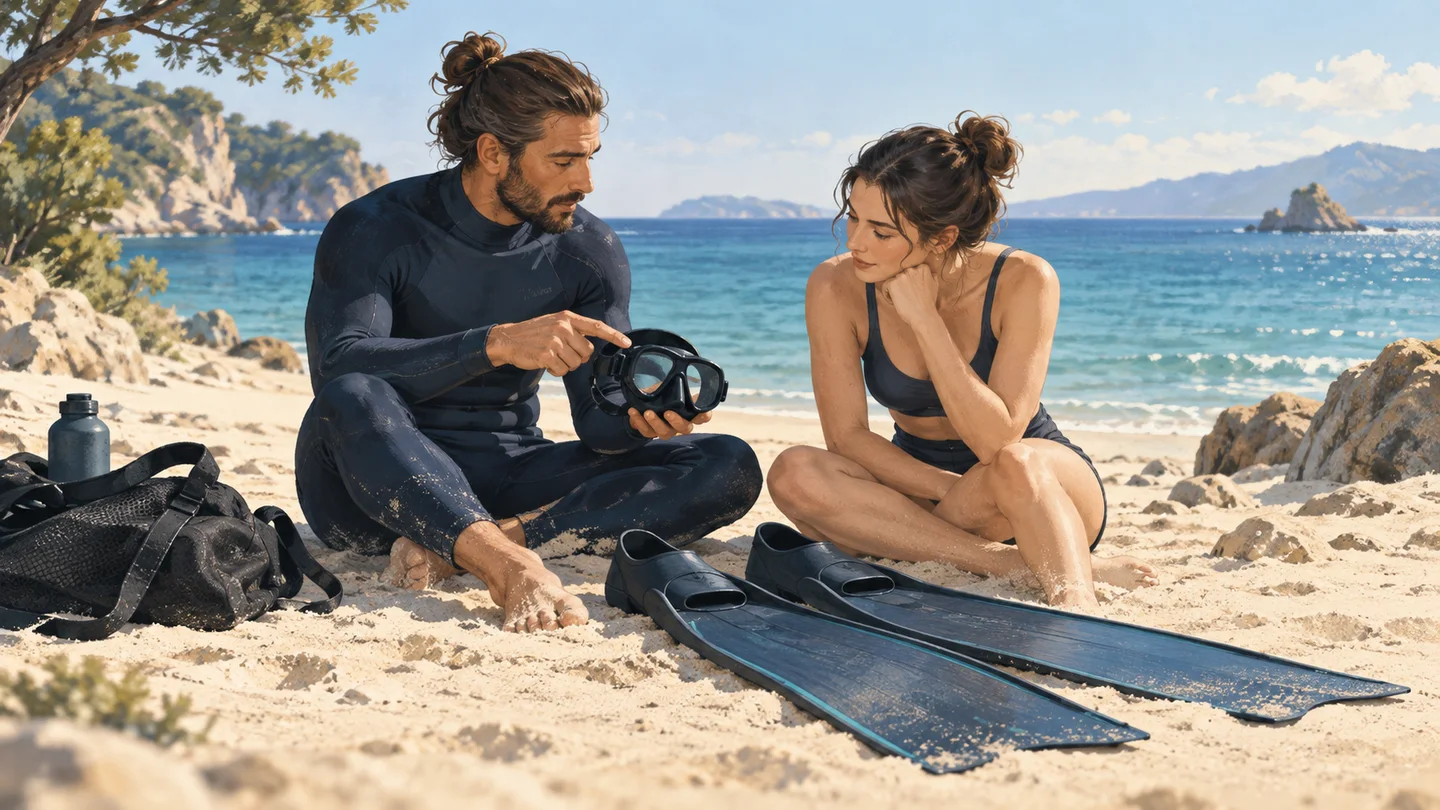
What freediving is
Freediving is diving on a single breath, without scuba equipment. It is practised as a sport, as recreation, and as a way of moving quietly underwater. The equipment list is short. The safety requirements are not.
Never dive alone. Hypoxic blackout can happen without a reliable warning, often near the surface during ascent, and it is fatal without immediate rescue. Never hyperventilate before a dive: it delays the urge to breathe while oxygen keeps falling.
Is it safe?
Freediving is a risk-managed activity, not an inherently safe one. Divers Alert Network's freediving safety guidance frames the core controls as trained supervision, conservative progression, and avoiding hyperventilation. Its explanation of hypoxia in breath-hold diving describes why the warning sensation can be absent exactly when you most need it.
The four rules that matter most:
- Never dive alone. A trained buddy watches the full dive and the recovery at the surface.
- Never hyperventilate. It removes the warning, not the risk.
- Progress gradually. Depth and time are the last things to push, not the first.
- Learn from a qualified instructor. Rescue skills cannot be self-taught from a screen.
We do not publish accident-rate comparisons between freediving and other activities. Reliable denominators for recreational participation do not exist, so any such figure would be invented.
Before the water: dry-land preparation
Dry practice is where you get familiar with breath-hold sensations without the drowning risk. Practise seated or lying down, away from any water.
Build a Dry-Land Foundation
Spend a few weeks getting comfortable with structured, sub-maximal holds before your first pool session:
- Short daily diaphragmatic breathing practice
- A conservative CO2 table a few times a week
- Relaxation practice, so that "relax on cue" is a skill and not a hope
What you are actually building is familiarity with the urge to breathe and the ability to stay still and calm through it. Rising carbon dioxide contributes substantially to that urge, alongside falling oxygen and respiratory-muscle activity, as described in a review of respiratory responses to a maximal apnoea.
The BreathHold app can structure and record these sessions. It cannot supervise you, and it is not a substitute for instruction.
Take a Certified Freediving Course
A course is not optional. It teaches buddy procedure, blackout recognition, rescue of an unconscious diver, equalisation, breathing before and after a dive, and efficient technique.
Recognised certification bodies include:
Entry-level courses generally run over a few days and combine theory, confined-water sessions, and open-water dives. Course content and depth limits vary by agency, so check the current standards with the school directly.
Practice in a Pool with a Buddy
Pool sessions are where technique and confidence are built.
Static apnea: floating face-down while holding your breath, with your buddy watching you continuously and ready to turn you over.
Dynamic apnea: swimming horizontally underwater. Start short and prioritise streamlining over distance.
Pool rules that do not bend:
- Your buddy stays within arm's reach and watches the whole attempt and the recovery
- No hyperventilation, ever
- No competitive repeat laps with short rest; this pattern is strongly associated with hypoxic blackout
- Use a supervised facility where possible
Learn Equalisation
Equalisation balances the pressure in your middle ears with the surrounding water. Without it, discomfort begins in the first few metres, and DAN notes that barotrauma can occur as shallow as one to three metres.
DAN's guidance is to equalise early, before your head goes under, and often, without waiting to feel pressure. If you feel discomfort, stop descending, ascend slightly, and try again. If it will not clear, end the dive.
Do not force a Valsalva. DAN's middle-ear equalisation reference warns that a forceful Valsalva against a blocked Eustachian tube can injure the inner ear. Freediving instructors generally teach the Frenzel technique instead; learn it from your instructor rather than from a video.
Progress to Open Water with Supervision
Your first open-water dives should be supervised by an instructor, along a vertical line, shallow, and in calm, comfortable conditions.
A sensible first progression is surface relaxation, then a short dive with a clean equalisation and a controlled return, repeated until it feels unremarkable. Depth follows comfort. It never leads.
Never compare your progression to anyone else's.
Train Consistently, Not Maximally
A workable week mixes a couple of dry sessions, a supervised pool session, and open water when conditions and supervision allow, with real rest days.
Avoid published week-by-week plans that promise specific times or depths. Reviews of apnoea training describe varied protocols and mixed outcomes, with no universal rate of improvement.
Equipment for beginners
Needed: low-volume mask, snorkel, long fins, wetsuit suited to the water temperature, and a weight belt with a quick-release buckle.
Useful later: dive computer, nose clip, and a lanyard with a float for open water. Your instructor will tell you when a lanyard is required for the diving you are doing.
Do not buy carbon fins before your first course. Plastic long fins are entirely adequate for a first year, and you will learn what you actually want.
The diving response
Breath holding, especially with the face in cool water, triggers oxygen-conserving responses: the heart slows, peripheral vessels constrict, and catecholamine release increases. A review of the human diving response describes its likely role as protecting the brain and heart, and notes that heart rates in breath-hold divers can fall substantially during a dive. The spleen also contracts and releases stored red blood cells, a short-lived effect measured in studies of repeated apneas.
The size of these responses varies widely between people and between dives. They are interesting physiology, not a safety margin you can count on.
Common beginner mistakes
- Going into the water before the sensations of a breath hold are familiar
- Training alone, in any water, for any duration
- Hyperventilating before a dive
- Chasing depth ahead of technique and equalisation
- Forcing equalisation instead of aborting the dive
- Skipping recovery breathing at the surface
- Measuring yourself against other divers
The mental side
Freediving rewards calm more than effort. The useful skills are accepting discomfort without reacting to it, staying with the present moment instead of the number, and letting go of a target dive when the day is not going well.
One caution: comfort is not a safety signal. Feeling relaxed deep into a hold means the warning is quieter, not that oxygen is fine.
Sources
- Freediving Safety, Divers Alert Network
- Hypoxia in Breath-Hold Diving, Divers Alert Network
- Ear Equalization Guidelines, Divers Alert Network
- Middle-Ear Equalization, Divers Alert Network
- The human diving response, its function, and its control (Foster & Sheel, 2005)
- Role of spleen emptying in prolonging apneas in humans (Schagatay et al., 2001)
- Respiratory system responses to a maximal apnoea
- Effects of apnoea training on aerobic and anaerobic performance
Ready to start training?
Build CO2 and O2 tables, follow guided sessions, and keep your training history in one place.


Related Resources
Why breath-holding accidents happen
A breath-hold accident is blackout: loss of consciousness as oxygen falls. On land people normally start breathing again; in water the airway is submerged. Here is how it happens and which controls actually prevent it.
ArticleApnea training: what it is and why dry practice works
Apnea training is structured dry breath-hold practice, usually on CO2 and O2 tables. The diving reflex is triggered by the hold itself rather than by the water, which is why dry sessions transfer, and where that transfer stops.
GuideHow to Hold Your Breath Longer: A Safe Dry-Land Starting Guide
Start with dry-land safety, a repeatable baseline, calm preparation, and conservative CO2 tables without relying on guaranteed timelines.