CO2 table vs O2 table: What changes in each session
CO2 tables shorten recovery while holds stay steady. O2 tables lengthen holds while recovery stays steady. Compare the formats before training.
The short answer
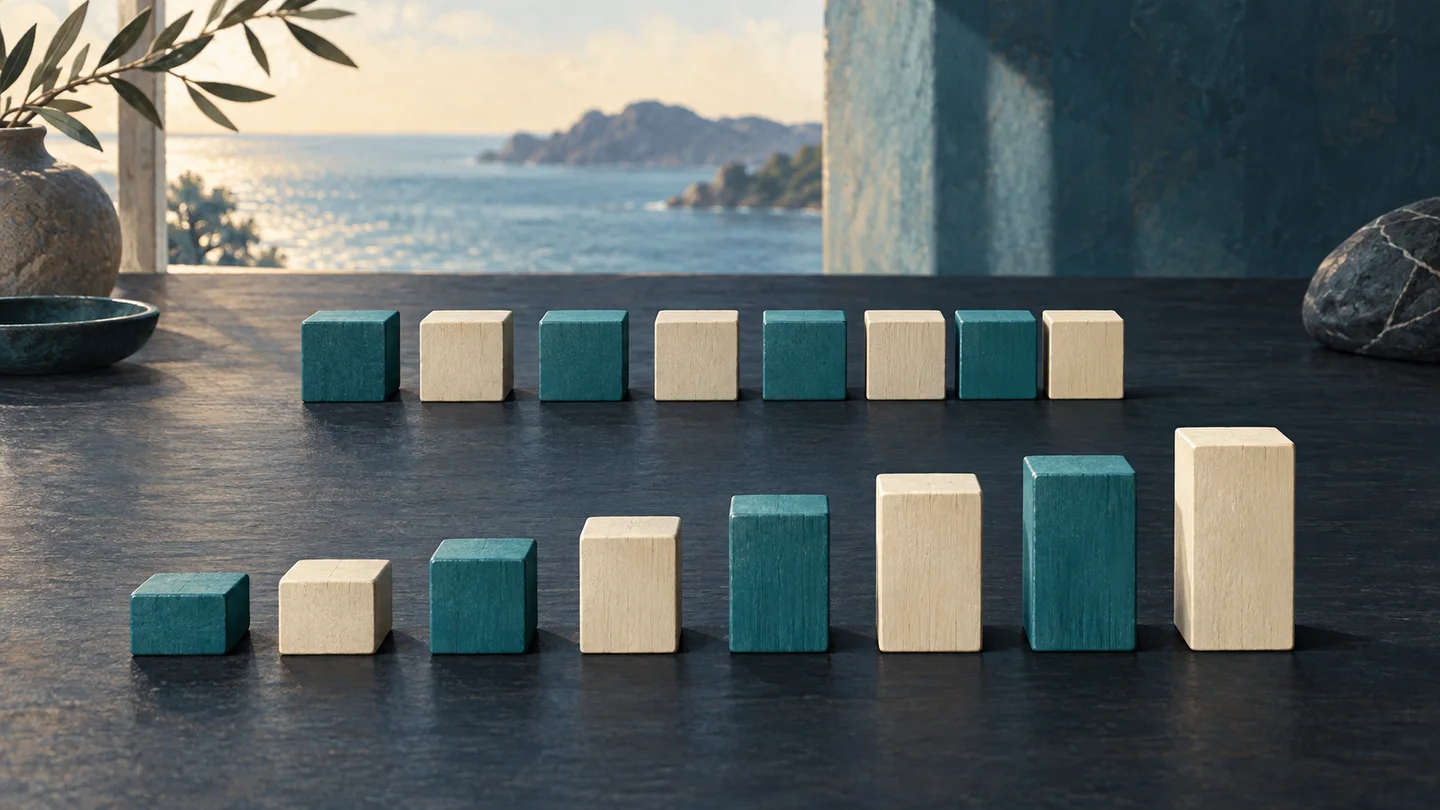
A conventional CO2 table keeps the breath-hold interval steady while the recovery interval gets shorter. A conventional O2 table keeps recovery steady while each hold gets longer. The names describe how the session progresses; neither table measures your blood gases or guarantees a particular training effect.
| Question | CO2 table | O2 table |
|---|---|---|
| What changes? | Recovery gets shorter | Hold gets longer |
| What stays steady? | Hold time | Recovery time |
| Does each round require a maximum? | No | No |
| Safe to do alone in water? | No | No |
| Available as a free web tool? | Yes | Yes |
How a CO2 table progresses
A CO2 table repeats the same hold while reducing the breathing interval before later rounds. Shorter recovery changes how the next hold feels because the body has less time between attempts.
The label is useful shorthand, not a direct gas reading. The session does not measure arterial carbon dioxide, and discomfort cannot tell you an exact value. Preparation, effort, baseline ability, and the chosen intervals all affect the response.
Read how to train with a CO2 table before building one. The CO2 table generator lets you inspect every round and shorten the plan before starting.
How an O2 table progresses
An O2 table leaves the recovery interval unchanged while increasing the hold duration. The later rounds therefore ask for longer apnea than the early rounds.
That progression can become demanding even when the first round feels easy. You do not have to complete a generated final interval. Review the entire table first and reduce the last holds when they approach your current limit.
The O2 table generator shows the full progression before the timer begins.
Which table should you choose?
Choose the variable you intend to practise. Use the CO2 format for steady holds with progressively less recovery. Use the O2 format for a sequence of longer holds with fixed recovery.
New users should not treat an O2 table as the automatic next step after a CO2 table. No universal order or frequency suits everyone, and no fixed percentage does either. A conservative CO2 table may be easier to keep submaximal because its hold time does not increase, but the final short recoveries can still be too hard.
If you cannot explain why every interval is in the session, shorten it or seek instruction. A simple plan you can review is more useful than an aggressive table generated from a stale personal best.
Can you combine CO2 and O2 changes?
Custom tables can change both rest and hold time, but that is no longer the conventional version of either format. Changing two variables also makes it harder to tell which part made the session more demanding.
Keep early sessions legible. Record the table, whether you completed it, and how recovery felt. Adjust one variable at a time rather than treating every completed session as a reason to increase the next one.
Safety rules for both formats
- Practise alone only on dry land, seated or lying somewhere stable.
- Never hyperventilate to delay the urge to breathe.
- End the session if you feel dizzy or unwell, or if recovery feels abnormal.
- Use a trained buddy for every in-water attempt; an app cannot supervise or perform a rescue.
The same rules apply even when the table uses moderate percentages. Read the breath-hold safety guide before using either timer.
Sources and limits
The table definitions match the current BreathHold implementation and the common structures described by apnea-training apps. The physiological limits follow reviews of apnea and breath-hold training. Those reviews do not establish one best table or a guaranteed improvement schedule.
- Effects of apnoea training on aerobic and anaerobic performance
- Respiratory responses during maximal apnea
- Divers Alert Network: Hypoxia in Breath-Hold Diving
Different apps implement these two formats differently — some ship both as presets, some generate them from a recorded best hold, some only let you assemble one in a custom builder. Best breath-hold apps in 2026 compares six of them on exactly that.
Ready to start training?
Build CO2 and O2 tables, follow guided sessions, and keep your training history in one place.


Related Resources
CO2 Tolerance Explained: What Changes During a Breath Hold
Learn how carbon dioxide, oxygen, lung volume, and respiratory signals contribute to breath-hold discomfort and the urge to breathe.
ArticleWhat is static apnea? Rules and safety
Static apnea is a timed breath hold without swimming. Learn how the discipline differs from dry practice and which safety rules apply.
GuideHow to Use a CO2 Table for Dry-Land Breath-Hold Training
Learn how a CO2 table works, choose a conservative starting session, avoid hyperventilation, and adjust the table without chasing a promised result.